The 10-Unit Condo: Why DC's Next Wave of Ownership Housing Could Be Small
Fannie Mae and Freddie Mac now let condo buildings of 10 units or fewer skip project review. Here's what that means for DC developers, buyers and agents.

In this article
The bottom line
This year Fannie Mae and Freddie Mac changed one condo rule that rewrites how buyers, sellers and developers handle small buildings. New and existing condo projects with 10 or fewer units (that aren’t part of a master association) can now skip agency project review entirely. Before, that waiver stopped at 4 units.
For a developer, that removes the presale wall that kept small condo buildings from penciling. For a buyer, it opens brand-new ownership housing with conventional financing at a smaller scale and price point than a 200-unit tower.
Stack that on top of DC’s new single-stair law, the RA-1 zoning update, and permit counts sitting near record lows, and I believe the 8 - 10 unit condo building is the most interesting product in DC real estate over the next 5 years.
There’s a catch on the buyer side, and a DC-specific wrinkle on the developer side that makes the sweet spot 9 units. I outline it all here.
What actually changed
Fannie Mae and Freddie Mac (the two agencies that set the rules for conventional mortgages) updated their condo rules this year. Most of the headlines focused on the stricter changes that made it more challenging for larger condo buildings: a full condo building review for every purchase or refinance and higher reserve requirements for condo associations starting in 2027.
Tucked into the same update is the change that matters here. Before, a condo building had to be 4 units or smaller to skip the agencies’ building review. Now the cutoff is 10 units, for brand-new and older buildings alike. Fannie estimates 15% to 20% more condo purchases now qualify to skip that review.
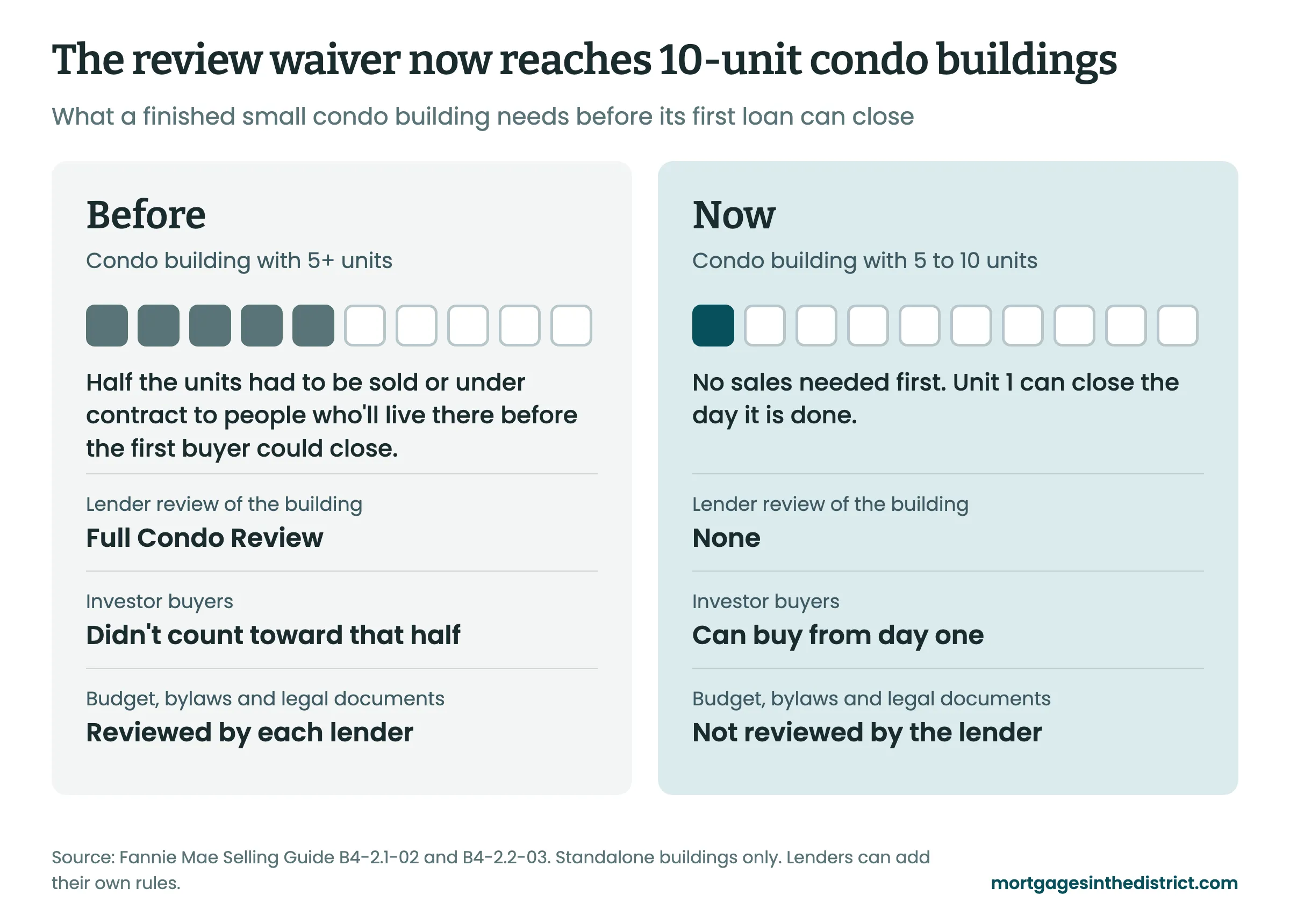
Two fine-print points that matter:
- Standalone buildings only. A 5 - 10 unit building that’s part of a larger community with a shared master HOA doesn’t qualify. A single infill building does.
- Your lender can be stricter. These are the agencies’ minimums. Individual lenders can add their own rules on top, so confirm with yours before building a sales plan around this.
The developer side: why this changes the pro forma
Under the old Full Condo Review, any new condo building with 5 or more units couldn’t close a single conventional loan until 50% of units were sold or under contract to people who’d live there, and the project had to be substantially complete.
For a small developer, it meant:
- A finished building could sit for months with multiple units under contract but none could sell until the “50% contract” threshold happened
- Construction loan interest running the whole time
- Investor buyers don’t count toward the threshold so developers may not accept their offer, effectively shrinking their buyer pool
- Legal review of the condo docs, budget review, reserve review, and the time each of those adds
With the new Full Condo Review waiver, unit 1 can close the day it’s done. Here’s what that looks like in carry alone.
Illustrative example (hypothetical numbers, not a quote): a $4.5M interest-only construction loan at 9% costs about $33,750 a month. If the waiver shortens the sell-out by 3 months because you’re no longer waiting to hit 50% presales, that’s roughly $100,000 back in the deal. On a 10-unit building, that’s about $10,000 per unit, which is real margin or real room on price.
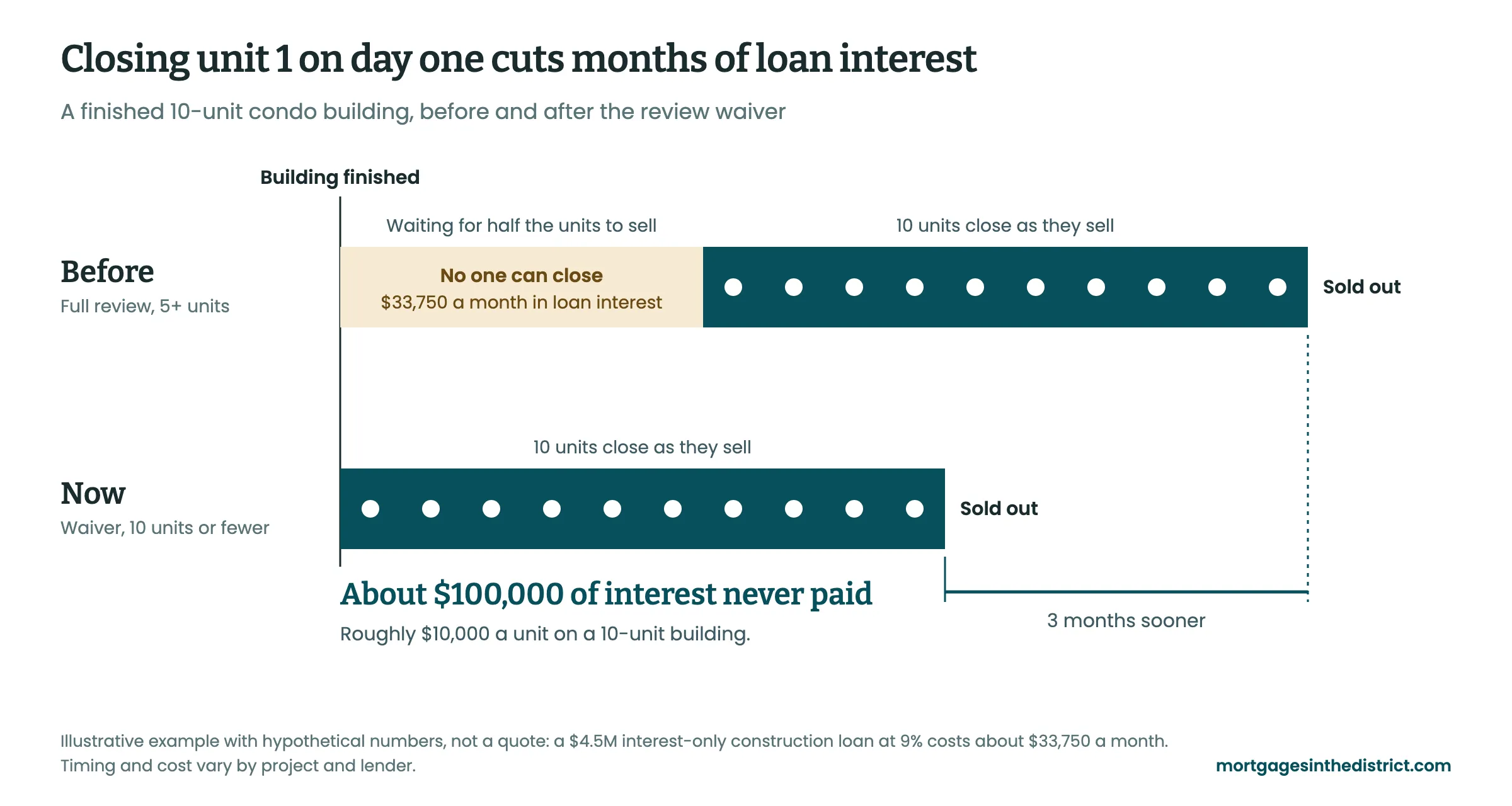
Illustrative example with hypothetical numbers, not a quote.
The other developer wins:
a) Sell to whoever is ready. Investors, second-home buyers and owner-occupants all close on the same terms from the agency side.
b) Lower soft costs. No lender-side legal document review for Fannie compliance. You still need good condo docs (you’re selling to people who’ll live with them), but you’re not drafting to pass a lender review checklist.
c) Faster construction loan payoff. Each closing pays down the construction loan sooner, which matters when your lender is pricing risk on a small-developer balance sheet.
d) A cleaner capital story. A 10-unit building with no presale contingency is easier to explain to an equity partner than one that depends on hitting 5 owner-occupant contracts in a soft market.
The buyer side: why this matters for the people buying
- New construction at a smaller scale. Most new DC ownership housing has come in large buildings with amenity packages, concierge and the condo fees that pay for them. A 10-unit walk-up or elevator building can deliver new construction without massive overhead.
- A more affordable price, with room for seller credits. A smaller building carries less overhead in its price, so units can come in below what large buildings charge for new construction. And because finished units no longer wait on presales, the developer isn’t paying months of loan interest on empty units. That saved carry is margin a developer can share with buyers as seller credits toward closing costs or a lower rate.
- Your vote actually counts. In a 10-unit association, you’re 1 of 10, not 1 of 200. You will know your neighbors and you’ll have a real say in how the building is run.
The catch: the review you lose
Just because lenders aren’t required to review condo documents and financials doesn’t mean buyers should blindly move forward.
Project review exists to protect the lender, but buyers benefit from it too. Under Full Review, someone checks the budget, the reserve allocation, the delinquency rate, the legal docs and the developer’s control of the association. With the waiver, no one on the lending side is doing that homework for you. Insurance still has to meet agency requirements, but the financial health of the building is on you.
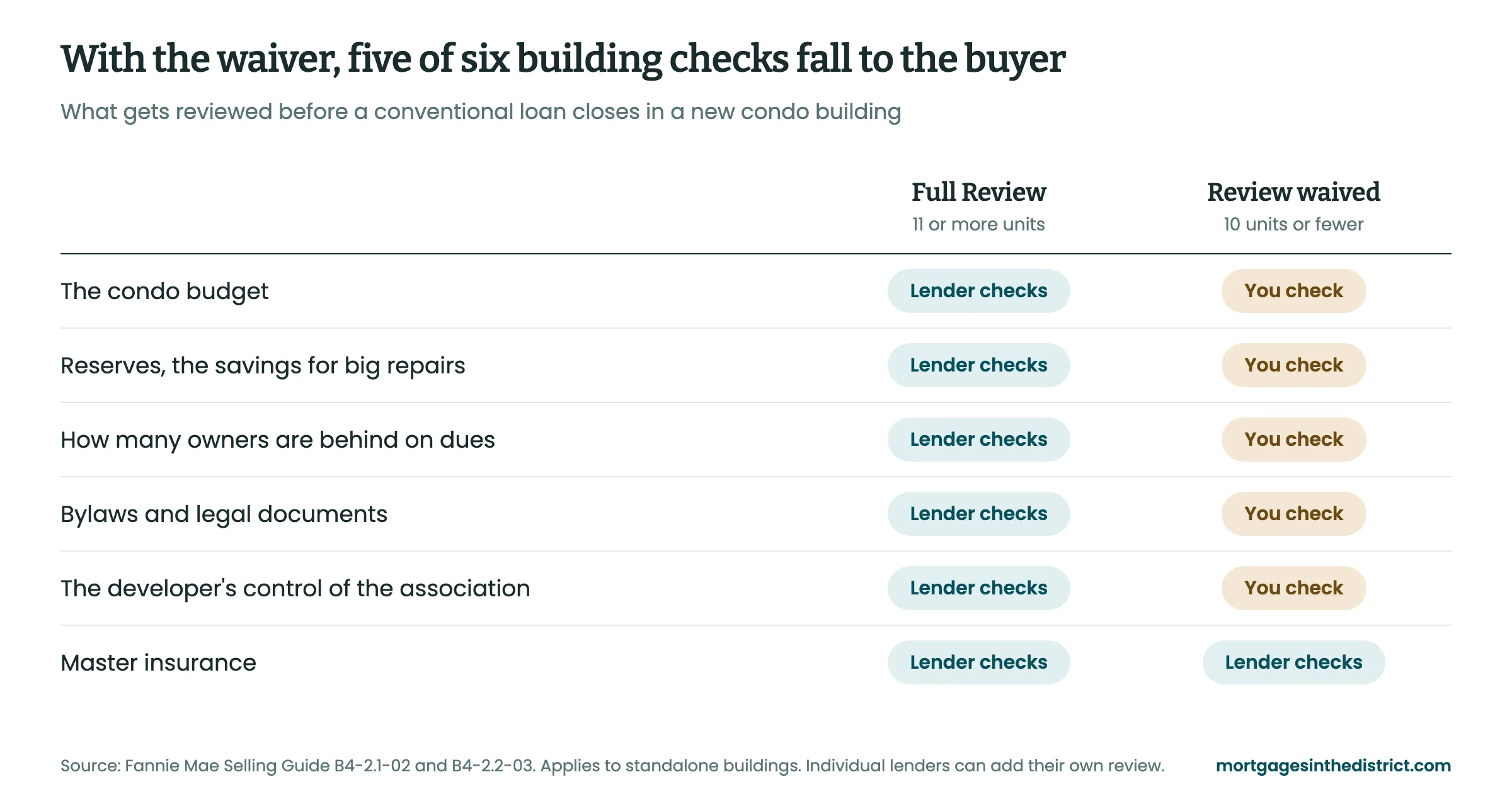
And in a small building, the costs can amplify. A $150,000 roof repair is $750 per owner in a 200-unit building. In a 10-unit building, it’s $15,000 per owner.
Buyer checklist for a 10-unit new construction condo:
- The budget. Is the developer’s proposed condo fee realistic, or set low to help sales? Ask how it was built and whether a reserve study backs it.
- Reserves. Fannie is moving Full Review projects to 15% of the budget for reserves. A waived project has no minimum. Ask what percentage is going to reserves anyway.
- The master insurance policy. Coverage, deductible, and who pays the deductible on a claim.
- Developer warranty and transition. What the developer warrants, for how long, and when owners take control of the association.
- Management. Professional management or self-managed? Self-managed small buildings can work well, but someone has to collect fees, pay the insurance and keep records.
- Rental mix. With no presale test, the building could close with a heavy investor share. That’s not automatically bad, but know it going in.
Why DC, and why now
The waiver is national. DC is where it could matter most, because the District’s new-construction pipeline has collapsed and the policy pieces for small buildings are falling into place at the same time.
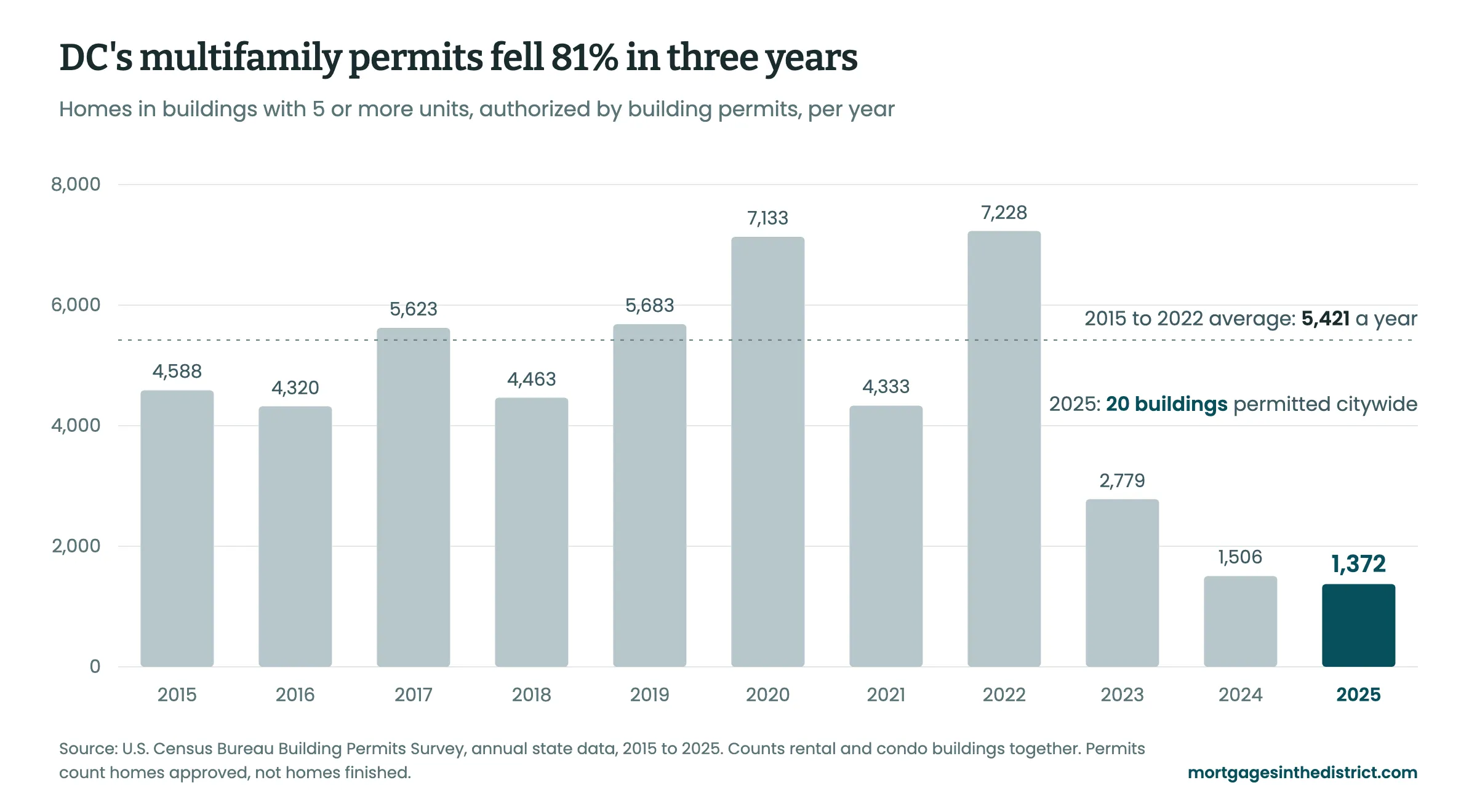
Source: U.S. Census Bureau Building Permits Survey, 2015 - 2025.
- Permits are near the floor. DC permitted 1,372 multifamily units in all of 2025, down from roughly 4,300 - 7,200 a year from 2015 through 2022. In January 2026, one multifamily building pulled a permit, for 30 units.
- Single-stair is coming. The DC Council unanimously passed the One Front Door Act, which allows residential buildings up to six stories with roughly four units per floor to be served by a single staircase (current code generally stops at three stories). DOB is directed to issue the rules by July 1, 2027. Research cited in the debate puts single-stair buildings at 6% to 13% cheaper to build than two-stair equivalents, and they fit on narrow infill lots where two stairs don’t.
- RA-1 opened up. The Zoning Commission’s RA-1 update (Case 25-08) allows rowhouses, flats and small apartment buildings up to six units by-right, with roughly 4,000 RA-1 properties that could theoretically be redeveloped to six units.
- The developers fit the product. In-District building is mostly small-to-mid developers and private equity doing redevelopment, not national builders land-banking subdivisions. That’s exactly the group that can execute a 6 - 10 unit infill building, and exactly the group the presale wall used to hurt most.
A single-stair, five-story building with two units per floor is a 10-unit condo. Those three changes line up almost perfectly.
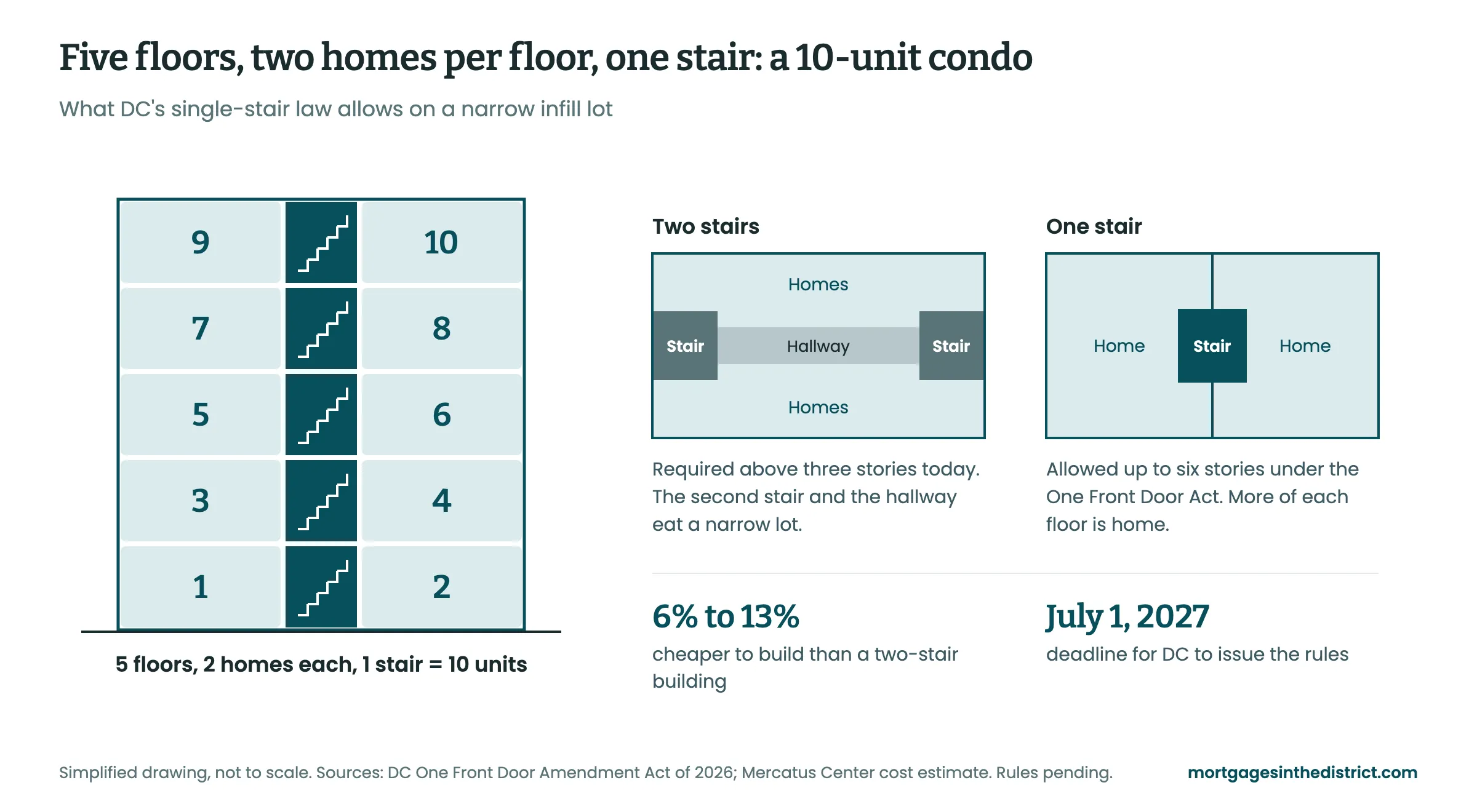
Simplified drawing, not to scale.
The DC wrinkle: is the real sweet spot 9 units?
DC’s Inclusionary Zoning program applies to new residential projects of 10 or more units, requiring roughly 8% - 10% of residential floor area to be set aside as affordable units, in exchange for up to 20% bonus density.
So the nationwide mortgage ceiling (10 or fewer for the waiver) and the DC trigger (10 or more for IZ) overlap at exactly the same number. That leaves a developer with a real decision:
- 9 units: mortgage condo waiver applies, IZ doesn’t apply. Simplest path, every unit sold at market.
- 10 units: waiver still applies, IZ now applies. One (roughly) affordable for-sale unit sold through DHCD’s lottery at a restricted price, but potentially bonus density that makes the site work better.
- 11+ units: mortgage waiver is gone and IZ applies. Back to Full Review and the 50% presale wall alongside the IZ considerations.
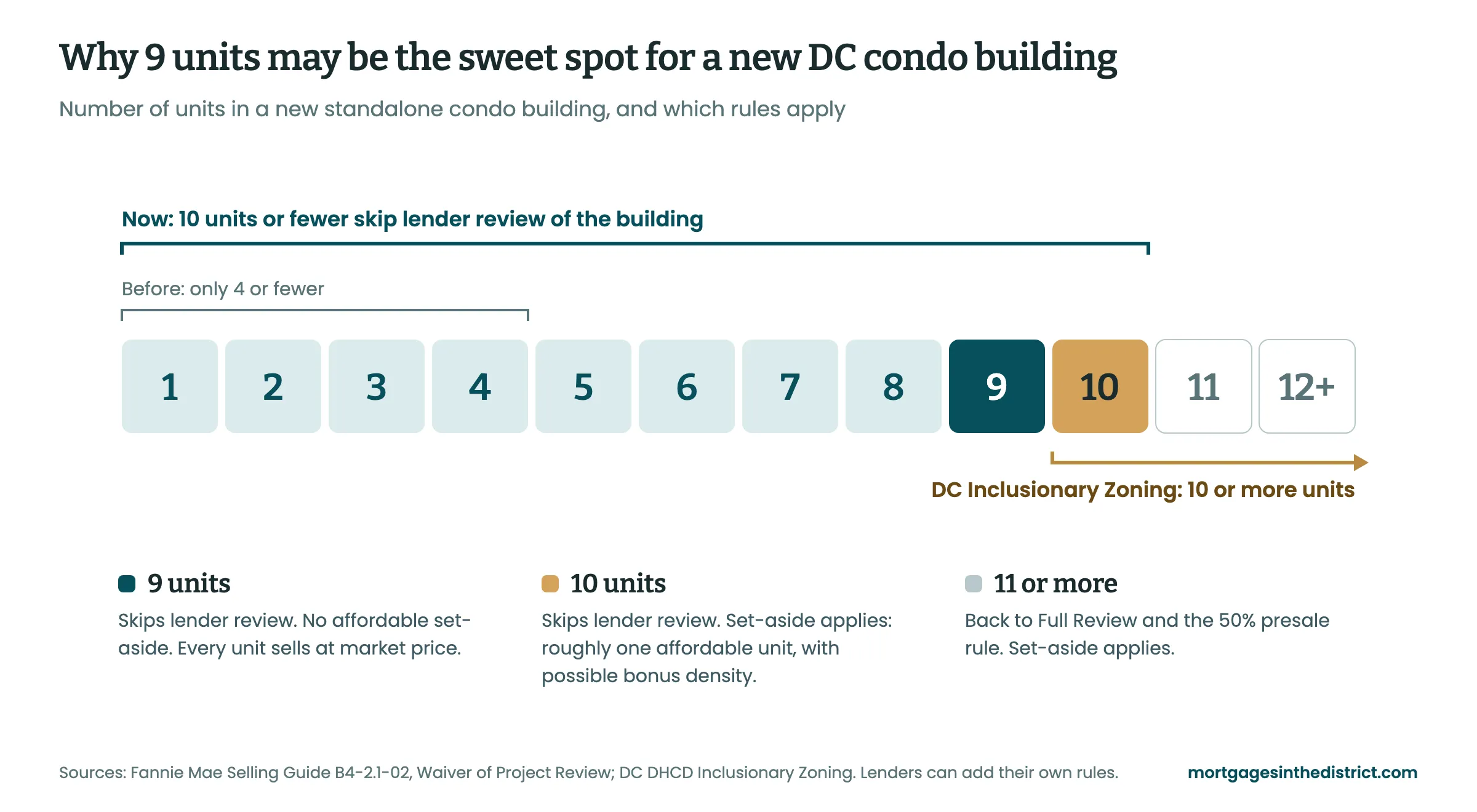
There isn’t one right answer. It depends on the lot, the zone and whether the bonus density is worth the IZ unit. But anyone underwriting a small DC condo building should be modeling 9 vs 10 on purpose rather than finding out at permit.
What I’d do with this and how we can help
If you’re a developer or builder in DC
- Model your next infill site at 9 and 10 units side by side, with and without the extra space inclusionary zoning allows.
- Confirm your buyers’ lenders will honor the review waiver without adding rules of their own.
- Build a real budget and reserve plan anyway. A believable condo fee is a sales tool, and it holds up when a buyer’s attorney or lender looks closely.
- Watch for DC’s single-stair rules. Sites that don’t work today may work in 2027.
Where our team comes in:
- A budget and condo docs buyers can trust. We help you build a realistic HOA budget and reserve plan, and review the condo docs from the mortgage side before you list, so nothing trips up a buyer’s loan.
- Infill construction financing. Construction loans built for small infill projects as well as 200-unit towers.
- A forward commitment for your buyers. Lock in a below-market rate for the project before delivery. For a buyer, a lower payment often beats a price cut, and it protects your comps.
- Faster closings. We review the project once, up front. Every buyer who finances with us starts from a building we already know, so contract to closing moves faster.
If you’re a buyer
- Treat the waiver as speed, not as a seal of approval.
- Get the budget, the reserve plan, the insurance details and the warranty in writing before your contingency ends.
- Plan for conventional financing, and check whether you qualify for DC’s down payment programs that pair with it.
Where our team comes in:
- A second set of eyes on the building. We walk you through the budget, reserves, insurance and warranty in plain language, so you know what you’re buying into.
- A cash offer. Compete like a cash buyer in a building where units move fast, then finance after.
- Access to the project’s rate. If the developer set up a forward commitment with us, you may qualify for a below-market rate.
- A faster closing. We’ve already reviewed the building, so your loan doesn’t start from scratch.
If you’re an agent
- Small new buildings are about to be a bigger share of new listings. Learn the waiver well enough to explain it in two sentences.
- Line your buyers up with a lender who knows the difference between a building that skipped review and one that was reviewed.
If you’re listing or selling units in one of these buildings, we can review the project and walk your buyers through the financing, so you’re not explaining condo rules at a showing.
Real estate & mortgage is a long game. The policy pieces for small buildings are landing now, and the projects they make possible will be permitted over the next few years. The people who understand the product first will be the ones building, selling and financing it.
Christian Kosko, Senior Mortgage Advisor, Mortgages in the District | Fairway Home Mortgage. NMLS# 1415795. Fairway Home Mortgage NMLS# 2289. Equal Housing Lender. Licensed in DC, MD and VA. This article is for educational purposes, does not constitute financial or legal advice, and all financing is subject to underwriting and lender requirements. Guidelines as of November 2026.
Sources
- Fannie Mae, Selling Guide B4-2.1-02, Waiver of Project Review (08/05/2026)
- Fannie Mae, Lender Letter LL-2026-03 (March 18, 2026)
- Fannie Mae, Selling Guide B4-2.2-03, Full Review requirements for new condo projects
- Fannie Mae, Condo and Property Insurance FAQs
- NAR, Changes in Condominium Underwriting Guidelines
- Homebridge Wholesale Bulletin 26-06 (Freddie Mac alignment)
- DC DHCD, Inclusionary Zoning for Residential Developers
- Greater Greater Washington, Approved zoning changes in DC (RA-1, Case 25-08 and 25-12)
- UrbanTurf, DC Council Advances One Front Door Act
- DC CFO Fiscal Impact Statement, One Front Door Amendment Act of 2026
- Mercatus Center, single-stair cost estimate
- NationGraph, DC multifamily permits 2025 - 2026
- ABA Banking Journal, FHA condo single-unit approval rule