DC vs Northern Virginia: The Housing Gap (Part 1)
DC permitted 1,591 homes in 2025, down 79% from 2022, while Northern Virginia's four largest counties fell about 10%. Why DC stalled, what's working elsewhere, and what it means from the mortgage side.

Why I’m writing this
In 2025, Washington, DC permitted 1,591 new homes. That’s the fewest since 2010, and 79% fewer than the 7,705 it permitted in 2022[1]. This year is on pace for roughly 436, which would be the lowest since 1998[6].
Across the river, Northern Virginia’s four largest counties permitted 7,072 homes in 2025, down only about 10% from 2022[2-5].
I’ve financed homes in the DMV for more than 11 years. I see where buyers go when they can’t find what they want in the District. More and more, they cross the river.
Here’s my take: DC’s housing slump is part federal economy, which the city can’t control, and part capital problem, which the city created and can fix. Lenders will still lend here. What’s missing is the equity (the investor money that goes in ahead of the loan) and the confidence that the rules won’t change halfway through a project.
This is Part 1 of a series. It covers the numbers, why DC stalled, what other places did to build more, and what this means from the mortgage side. Later parts go deeper on unpaid rent, the cost of publicly funded buildings, and the ownership gap.
(Full disclosure: more homes in DC would mean more buyers, and I’d benefit from that. I’d rather say it up front.)
By the numbers
Here’s DC against Northern Virginia’s four largest counties, combined and one by one, since 2015[1-5].
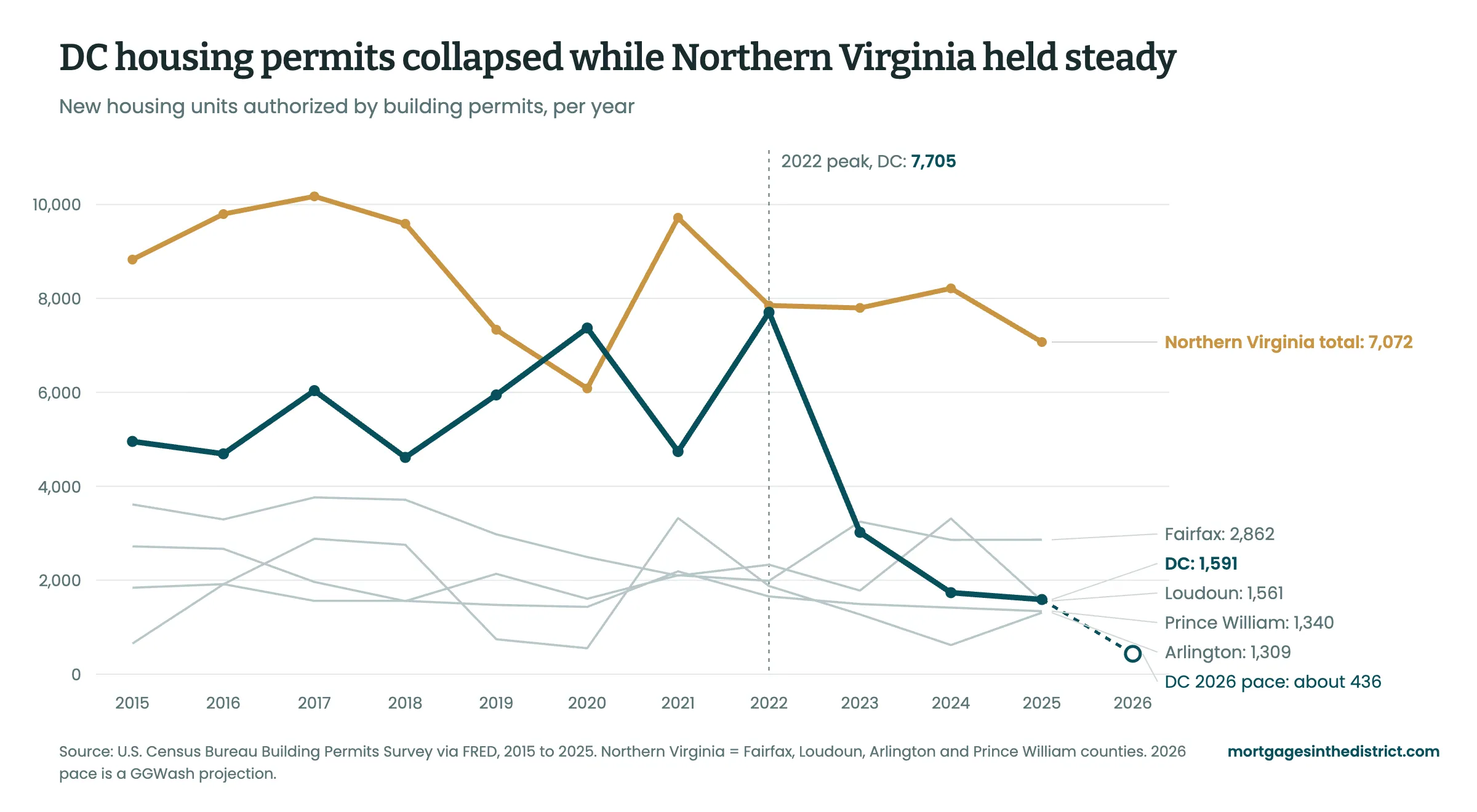
Source: U.S. Census Bureau Building Permits Survey via FRED, 2015 - 2025[1-5]. Northern Virginia = Fairfax, Loudoun, Arlington and Prince William counties. 2026 pace is a projection from GGWash[6].
In 2022, DC permitted nearly as many homes as Fairfax, Loudoun, Arlington and Prince William combined, with less than a third of their population. By 2025, those four counties permitted more than four times as many as DC[1-5, 8-12].
Population matters, so here’s the same year on a per-person basis.
| Jurisdiction | Homes permitted, 2025 | Residents, 2025 | Permits per 1,000 residents |
|---|---|---|---|
| Arlington | 1,309 | 243,931 | 5.4 |
| Loudoun | 1,561 | 449,749 | 3.5 |
| Prince William | 1,340 | 502,966 | 2.7 |
| Fairfax | 2,862 | 1,167,873 | 2.5 |
| District of Columbia | 1,591 | 693,645 | 2.3 |
Permits[1-5]; population, July 2025 Census estimates[8-12].
Other signals point the same way:
- Starts: 1,933 residential units broke ground in DC in 2025, up from 1,362 in 2024. Both years were less than half of every other year in the past decade[7].
- Pipeline: Units under construction at the end of 2025 were down 19% from a year earlier[7].
- Mix: Much of what did start was office-to-residential conversion, not ground-up building[7].
A note on the data: permits count homes approved, not homes finished. County totals can swing when one big project gets its permit (Loudoun in 2024, for example). I left Alexandria out because its Census permit counts for recent years look incomplete.
Why DC stalled
Four forces hit DC at once. Northern Virginia felt the first one. It mostly avoided the other three.
1. Demand fell. Federal workforce cuts, a long shutdown and a stalling private sector cut into demand. DC’s apartment vacancy rate rose from about 6% in 2023 to 8% in 2026, and rents turned negative over the past year[6]. Nobody builds into falling rents. That part isn’t a DC policy failure.
2. Equity is an issue. Developers have sites and drawings ready, but no investors willing to put money in first[14]. The city’s own subsidy system doesn’t fill that gap. The D.C. Policy Center called this year’s big housing bill “a housing finance bill, and not a production reform bill”[27].
3. Unpaid rent broke the math. Developers used to assume about 5% “economic vacancy” (rent that doesn’t get collected). In DC they now assume 7% to 10%, and one principal said it “completely wrecks the pro forma”[13]. Foreclosure sales of 5- to 50-unit buildings rose from 14 to 29 in 2025[15].
4. Slow courts and slow sales. DC’s landlord-tenant court still runs on a virtual calendar. Virginia and Maryland went back to in-person court years ago, and fewer cases settle when the parties never meet[6]. Developers have long blamed DC’s 45-year-old Tenant Opportunity to Purchase Act (TOPA) for delaying building sales[13].
What DC has already fixed
To be fair, the city has acted.
- The RENTAL Act took effect December 31, 2025[16]. New buildings are exempt from TOPA for their first 15 years, and most two- to four-unit buildings are now exempt too[17].
- Emergency rental assistance went back toward its pre-pandemic rules, ending the open-ended eviction stays[6].
- Small buildings got easier. As of July 2026, rowhouses, flats and apartment buildings of up to six units can be built by right in the RA-1 zone[31]. The One Front Door Act directs the Department of Buildings to allow single-stair buildings up to six stories, with rules due by July 1, 2027[32].
- Housing in Downtown, a 20-year tax abatement for office-to-residential conversions, had 14 projects and more than 1,900 units underway by the end of 2025[7]. Per resident, the DC area now has the largest office-to-apartment conversion pipeline in the country (8,479 units), about 1.6 times New York’s (16,358 units)[29, 30].
- The 36,000-home goal set in 2019 was hit ahead of schedule[28]. But that goal was hit with 2019-era interest rates and investors.
These changes are recent, and capital moves slowly. Investors want to see a few years of predictable rules before they come back.
What’s working elsewhere
Each of these places attacked a different bottleneck. DC has all of them at once, so it can take a lesson from each.
Northern Virginia: steady beats stalled
Northern Virginia isn’t booming on permits. It’s steady, and in this market steady beats DC by a wide margin.
The fairest comparison is Arlington. It and DC have almost the same homeownership rate, 41.3% and 41.5%[8, 9]. Both are dense, transit-rich and rental-heavy, and both feel the federal slowdown. Yet in 2025 Arlington permitted 5.4 homes per 1,000 residents, against DC’s 2.3[1, 4, 8, 9].
- It lets housing go where the jobs are. Tysons rezoned for density and added a bigger share of new housing than any other Virginia locality from 2017 to 2022. Its rents rose just 5% over seven years, the lowest growth in the state[18].
- It’s willing to fight for zoning reform. Alexandria ended single-family-only zoning in 2023, and a judge upheld it after a neighbor lawsuit[19]. Arlington’s Missing Middle reform was overturned in circuit court in 2024[20]. Reform there is messy, but it’s on the table.
Montgomery County: fill the equity gap directly
Montgomery County’s $100 million Housing Production Fund attacks DC’s exact problem. The county issues bonds and lends to its housing agency (HOC) for construction. HOC keeps majority ownership, so public money takes the place of the private equity DC can’t find right now[22].
Once a building is finished, the loan is repaid and the money moves to the next project. At least 30% of units are income-restricted (20% at 50% of area median income, 10% at about 65 - 70%), and the fund uses no tax credits, vouchers or housing trust fund money[22]. Its first building, the 268-unit Laureate, opened in 2023, and two more (876 units) are underway[22].
Austin: volume and speed
Austin added 120,000 homes from 2015 to 2024, a 30% jump, after upzoning near jobs and transit, dropping parking minimums for nearly all properties and passing $600 million in housing bonds[23]. Its median rent fell from $1,546 to $1,296[23]. The biggest relief went to renters at the bottom: Class C rents fell about 11% from 2023 to 2024, against 2.6% for Class A[23]. Austin also halved its site plan review times in a year[23]. Speed is a policy choice.
Two more worth knowing
| Place | What they did | What happened | The lesson for DC |
|---|---|---|---|
| Minneapolis, MN | Ended parking minimums, allowed duplexes and triplexes on all residential lots, required density along corridors[24] | Housing stock grew 12% from 2017 to 2022, against 4% statewide[24] | Zoning reform pays off, but slowly |
| Arlington, VA + Amazon | An anchor employer lends below market to preserve and build affordable homes[26] | Committed affordable stock up 22%, per Amazon[26] | Recruit DC’s anchor institutions as lenders |
What this means from the mortgage side
Most housing debates are about renters and developers. From where I sit, there are four more things worth knowing.
1. DC builds homes to rent, not homes to buy
Rentals made up 92% of DC’s new housing construction over the last decade[6]. Only 41.5% of DC homes are owner-occupied, compared with 68.6% in Fairfax and 77.9% in Loudoun[8, 10, 11].
First-time buyers, including the DCHFA and HPAP buyers I work with every year, end up competing for older condos and rowhouses. Older condos bring their own hurdles: questionnaires, reserve reviews, special assessments and sometimes a “Non-Warrantable” status that limits which loans are available. When DC stops building, it stops building the next generation of starter homes.
2. Lenders still lend. That’s the tell.
When developers say “debt is not the problem”[14], they’re telling you something. Banks will lend against DC buildings that pencil. The money that won’t come in is the first-loss equity that has to go in before the loan.
Lenders size commercial loans by DSCR, the debt service coverage ratio: net income divided by the mortgage payment. Around 1.2 is considered safe, and below 1.0 the building can’t cover its loan. In 2024, the median DC tax-credit building had a DSCR of 0.81, against 1.46 nationally. DC was the only jurisdiction in the country with negative average cash flow[6].
No underwriter can fix a number like that. Only rent collection and predictable rules can.
3. The four-unit line
Small buildings just got easier to build in DC. For buyers and builders, the line that matters is four units, and it matters twice.
Up to four units, an owner-occupant can buy with a residential mortgage, and part of the expected rent may count toward qualifying (subject to underwriting). Most two- to four-unit buildings are also exempt from TOPA[17]. At five units and up, it’s a commercial loan sized on the building’s rent and DSCR, and the building stays under TOPA unless it’s new construction inside its 15-year exemption[17].
For a first-time buyer, a two- to four-unit building with a residential loan and no TOPA process is one of the simplest ways into DC ownership that also adds rental housing.
4. Today’s slowdown is a 2028 inventory problem
New condos and townhomes usually take two to three years to plan, permit, build and sell. New condo buildings also need project approvals and enough presales before many buyers can use agency or FHA financing. A thin pipeline in 2025 and 2026 shows up as thin new inventory for buyers later in the decade.
For buyers, the soft market cuts both ways. There’s less competition today, and there will be less new product later.
A playbook for DC
A new mayor and Council take office in January 2027[6]. If I were handing them one page, these are the seven things on it, in the order I’d tackle them.
- Start a revolving production fund. Follow Montgomery County’s model: construction loans that get repaid and lent again, for mixed-income buildings with at least 30% income-restricted units[22]. Start it as a dedicated account alongside the Housing Production Trust Fund, run by the DC Housing Finance Agency, so deep-affordability dollars aren’t cut. It goes straight at the equity gap developers keep describing[14].
- Finish the eviction-court fix. Bring landlord-tenant court back in person, as Virginia and Maryland did[6]. Investors underwrite how long it takes to enforce a lease, not just what the law says.
- Promise rule stability in writing. The RENTAL Act changes are less than a year old[16]. Commit to no new retroactive tenant or tax rules on buildings that start construction in the next five years. Investors charge more when the rules might change.
- Make more housing legal by right. Allow apartments by right on commercial corridors and near Metro, and drop remaining parking mandates. Tysons and Austin show this works[18, 23].
- Put a clock on permits. Set published review-time targets and report against them. Austin cut site plan review times by more than half in a year[23].
- Build for ownership, not just rent. Give condos, townhomes and small-lot homes the same priority rentals get.
- Recruit anchor institutions as lenders. Amazon did it in Arlington[26]. DC’s universities, hospitals and largest employers could fund below-market loans for workforce housing near their campuses.
None of these require new federal money. Most require the city to act like a reliable partner to the people who put money into buildings.
What the other side says
There are serious objections to this argument. Here are the strongest ones.
- It’s the economy, not policy. Patrick McAnaney of Somerset Development argues the market-rate slowdown comes mainly from federal job cuts and falling demand. On that view, DC needs to keep and attract residents more than it needs new rules[6].
- Supply already worked. DC permitted 19,815 homes from 2020 to 2022, and rent growth cooled as a result[6]. With vacancy at 8%, building more right now could deepen losses for existing owners.
- Zoning reform isn’t magic. The Minneapolis Fed found that the city’s slower rent growth after its 2040 Plan came mostly from weaker demand, not new supply, and that construction has lagged recently[25].
- Tenant protections exist for a reason. Councilmember Brianne Nadeau has called TOPA a “bedrock for tenants rights,” while agreeing it can be improved[13]. Faster evictions have real human costs, and “rule stability” can sound like a promise never to protect tenants again.
- Public money carries public risk. If a publicly funded building underperforms, taxpayers own the loss. Montgomery County’s model depends on getting repaid, and that hasn’t been tested through a downturn like DC’s.
- Virginia isn’t a clean model either. In 2026, Gov. Spanberger’s plan to allow apartments by right on commercially zoned land stalled after local governments pushed back[21]. Most of Virginia’s reforms still happen one county at a time, and some end up in court[20].
My view: all of these are fair. None of them fully explains why Arlington, which is exposed to the same federal slowdown, permitted homes at 2.3 times DC’s rate last year.
What’s next in this series
- Part 2: Unpaid rent and the landlord math. How rent nonpayment, virtual court and DSCR pushed DC’s affordable buildings toward foreclosure, and what it means for small landlords and investors.
- Part 3: Why publicly funded buildings cost more. How Jubilee Housing financed Ontario Place at about $1.2 million per apartment, and the reforms on the table.
- Part 4: The ownership gap. Condos, Non-Warrantable buildings, DCHFA and HPAP buyers, and what a rental-only pipeline means for first-time buyers.
- Part 5: Office-to-residential conversions. Do they pencil without a tax break, and who finances them?
- Part 6: A scorecard for the new mayor and Council. What they promised, what they did and what the permit numbers say.
If you’re an agent, developer or policymaker with data or a story for one of these, send it my way.
Sources
- U.S. Census Bureau via FRED, New private housing units authorized by building permits, District of Columbia (annual, updated May 28, 2026)
- U.S. Census Bureau via FRED, Building permits, Fairfax County, VA
- U.S. Census Bureau via FRED, Building permits, Loudoun County, VA
- U.S. Census Bureau via FRED, Building permits, Arlington County, VA
- U.S. Census Bureau via FRED, Building permits, Prince William County, VA
- Patrick McAnaney, Greater Greater Washington, The District’s twin housing investment crises (June 4, 2026)
- Bisnow, Construction In D.C. Plummets To 15-Year Low Point (April 7, 2026), citing the WDCEP Development Report
- U.S. Census Bureau, QuickFacts: District of Columbia
- U.S. Census Bureau, QuickFacts: Arlington County, VA
- U.S. Census Bureau, QuickFacts: Loudoun County, VA
- U.S. Census Bureau, QuickFacts: Fairfax County, VA
- City Population, Virginia counties and independent cities (Prince William County 2025 estimate)
- Bisnow, D.C. Housing Starts Drop 79% As Investors ‘Move Their Money Elsewhere’ (April 23, 2025)
- Bisnow, Barren Equity Market For D.C. Development Keeping Projects On Ice (April 2026)
- The Washington Times, Report finds D.C. rental property foreclosures surged (January 26, 2026), citing the Small Multifamily Owners Association
- Ballard Spahr, New TOPA Law and Other Important Legal Developments (January 2026)
- Federal Title, DC’s New TOPA Law: RENTAL Act Effective December 31, 2025
- The Pew Charitable Trusts, Zoning Flexibility Could Help Tame Virginia’s Soaring Housing Costs (February 13, 2024)
- Patch, Zoning For Housing Reforms To Boost Alexandria Housing Upheld In Court
- ALXnow, After Arlington Missing Middle changes overturned, Alexandrians wonder if Zoning for Housing is next (September 27, 2024)
- HousingWire, Virginia by-right zoning push fails (March 18, 2026)
- Housing Opportunities Commission of Montgomery County, Housing Production Fund
- The Pew Charitable Trusts, Austin’s Surge of New Housing Construction Drove Down Rents (March 18, 2026)
- The Pew Charitable Trusts, Minneapolis Land Use Reforms Offer a Blueprint for Housing Affordability (January 4, 2024)
- Federal Reserve Bank of Minneapolis, Unpacking supply and demand in rent trends since the Minneapolis 2040 Plan (2025)
- Office of the Mayor, Amazon commits $147 million to create and preserve 1,260 affordable homes
- D.C. Policy Center, Testimony on B26-0597, Housing Production Omnibus Amendment Act of 2026 (March 30, 2026)
- Bisnow, Bowser Claims Victory On Goal Of Adding 36,000 New Housing Units To D.C.
- Multifamily Executive, citing RentCafe, Office-to-Apartment Conversions Surge as Pipeline Nears 100,000 Units (March 27, 2026)
- StatRanker, U.S. Metro Areas by Population: 2026 Snapshot Based on 2025 Census Estimates (New York metro 20,112,448; Washington metro 6,465,724; July 1, 2025)
- DC Office of Planning via Greater Greater Washington, Approved zoning changes in DC remove barriers to housing (2026)
- DC Office of the Chief Financial Officer, Fiscal Impact Statement: One Front Door Amendment Act of 2026